
A year ago, California was experiencing one of its driest wet seasons on record. The dryness turned into tragedy, with devastating wildfires in and around Los Angeles. This year, the climate has whiplashed back to wet. In southern California, it’s the wettest start to the water year in more than 20 years, according to the National Weather Service, and the 4th-wettest on record dating back to 1877.
This animation captures the natural phenomenon at the heart of the region’s big swings in precipitation from year to year: transient atmospheric rivers that carry massive amounts of water vapor into the mid-latitudes from as far away as the tropics. When the warm, wet air climbs West Coast mountains, it cools and unleashes huge amounts of snow and rain. These rivers of water vapor can flow for hours or even days at a time, providing a steady supply of moisture to mid-latitude weather systems such as cold fronts, cut-off lows, and extratropical cyclones.
Not only can atmospheric rivers deliver huge amounts of precipitation in a single event, they also tend to cluster, occurring virtually back to back within a season. It’s this behavior—and whether a season has a lot of atmospheric rivers or few—that is largely responsible for the huge spread between California’s wettest and driest years.
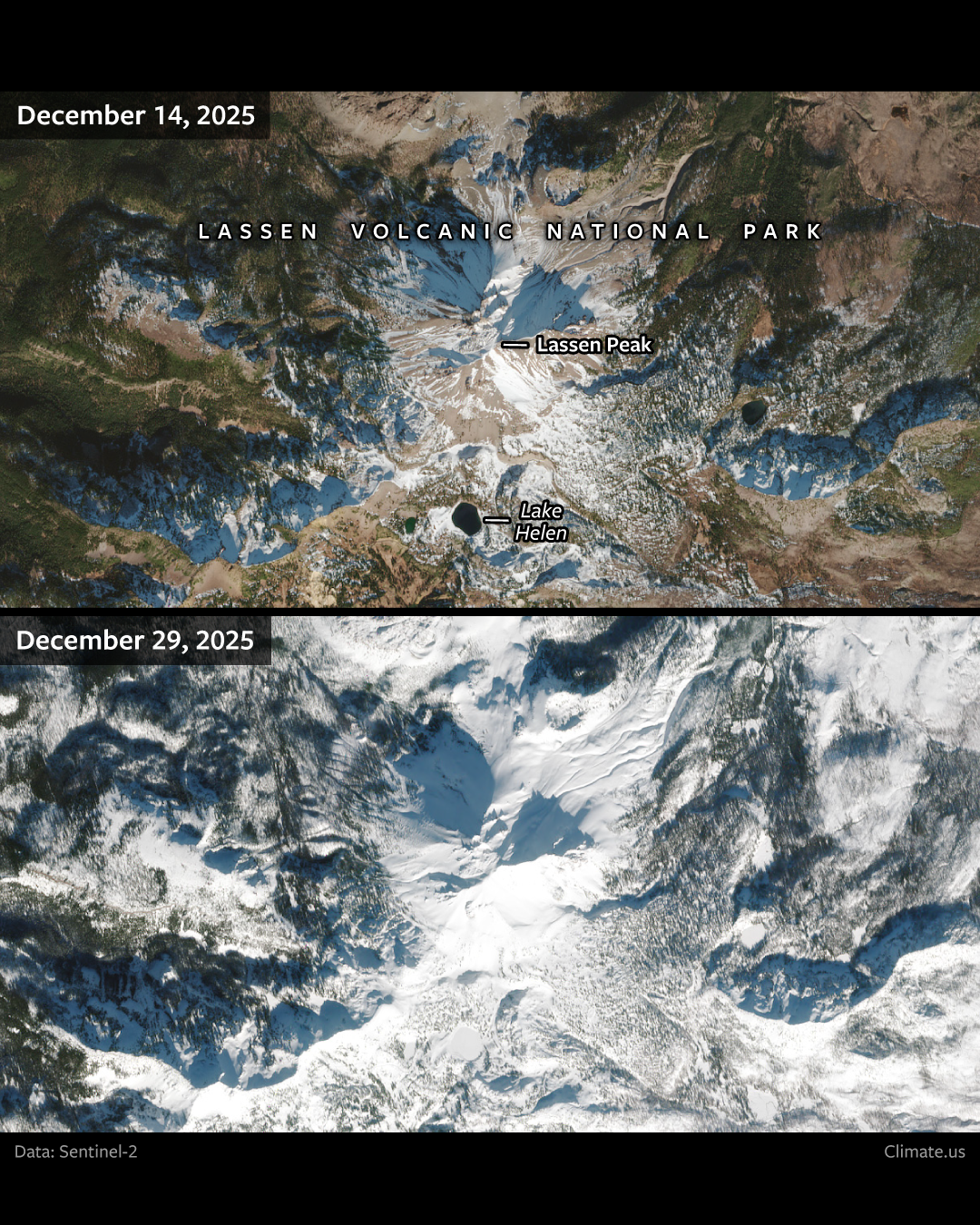
The event captured in the January 5 animation was the second of two that struck the U.S. West Coast in the first week of January. According to an event summary from the Center for Western Weather and Water Extremes:
The remnants of the first AR [atmospheric river] and the second AR impacting northern California and southern Oregon in quick succession led to ~70–85 hours of AR conditions… . 10+ inches of precipitation was received in portions of the California Coast Ranges, the highest elevations of the Transverse Ranges and in the northern Sierra Nevada… . An estimated 24–48 in. of snow fell across much of the Sierra Nevada, with snowfall totals exceeding 72 in. over the highest elevations.
By bringing repeated rounds of heavy precipitation, atmospheric rivers can cause flooding, avalanches, and landslides. They can increase fire activity in the following dry season. But they also recharge the region’s surface water supplies and can bring an end to deep drought. Given their importance to extreme events and water supplies in the West and other parts of the country, climate and weather scientists are working to understand every aspect of atmospheric rivers, including how to detect and describe them in a globally consistent way, if they can be predicted farther in advance, and how climate change might affect their strength or frequency.
More information
- USGS atmospheric river rating system
- NOAA atmospheric rivers portal
- NASA atmospheric rivers page
- USDA atmospheric rivers page
- Center for Western Weather and Water Extremes
Data
- GOES West (GOES 18), NOAA
- Sentinel-2 L2A, Copernicus (EU)