Concentration of carbon dioxide is about 1.4 times what it was before the Industrial Revolution. How much and how fast will Earth warm if carbon dioxide concentrations double the pre-industrial?
Today's global warming is happening at a much faster rate today than it did in the warm periods between ice ages over the last million years.
Business leaders can evolve their business models to stay profitable while improving their energy efficiency, reducing their carbon emissions, and reducing their, and their climate-related risks.
Societies, governments, and individuals can take steps to reduce risks and vulnerabilities to shifting climate and weather events in their homes, communities, and businesses.
NOAA is an agency that enriches life through science. From the surface of the sun to the bottom of the ocean, NOAA advances scientific understanding of Earth's environment, climate, and weather.
Among the questions triggered by the entrapment of a Russian ship near Antarctica on Christmas Eve were whether the ice conditions were out of the ordinary, and, if so, whether long-term climate change was playing a role.
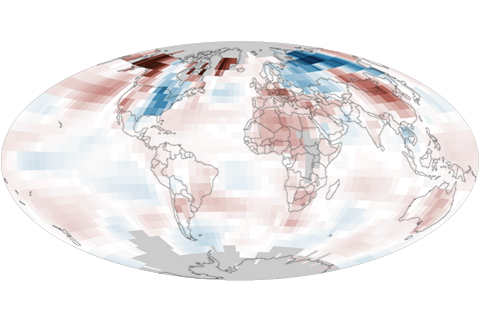
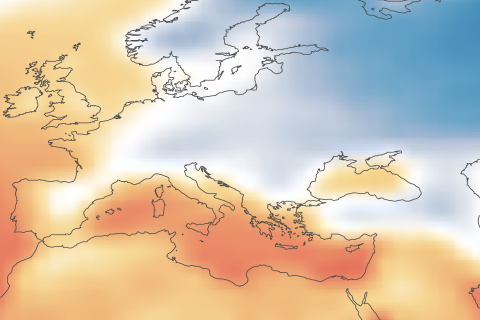
The globally averaged temperature for 2013 tied as the fourth warmest year since record keeping began in 1880, according to NOAA scientists. It was the 37th consecutive year with a global temperature above the 20th-century average. This animation starts with the 2013 difference from average temperature and continues through monthly temperature anomalies for January-December.
The Arctic Oscillation describes simultaneous, geographically “choreographed” shifts in multiple features of the polar vortex: air pressure, temperature, and the location and strength of the jet stream. They all follow the hemisphere-wide oscillation of atmospheric mass back and forth between the Arctic and the middle latitudes, sort of like water sloshing in a bowl.
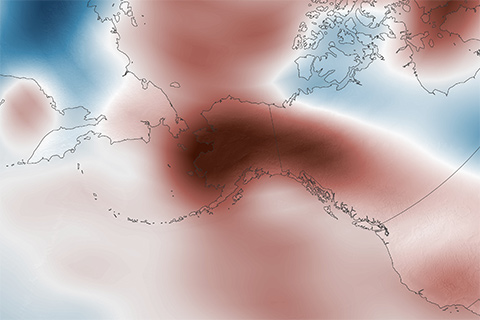
A few days of unusually cold weather in the U.S. and Canada aren't a sign that a century-or-more trend of rising global surface temperatures has reversed itself. In fact, the cold wasn't even all that widespread for the Northern Hemisphere.
Meteorologists have known for years that the pattern of the polar vortex determines how much cold air escapes from the Arctic and makes its way to the U.S. during the winter. Climate scientists are wondering if a warmer Arctic could explain its odd behavior in recent years.