Climate change: spring snow cover in the Northern Hemisphere
This page was last updated on Climate.gov in May 2025. Climate.us updates began in June 2026.
Satellite images from the last five decades show that spring snow cover is disappearing earlier in the year than it did in the past. The area of snow-covered ground is declining most rapidly in June, a month when, historically, Siberia, Alaska, and northern Canada remained partially snow covered. Across the Northern Hemisphere, the total area covered by snow during March and April—the end of the snow season for much of the mid-latitudes—has also shrunk over time.
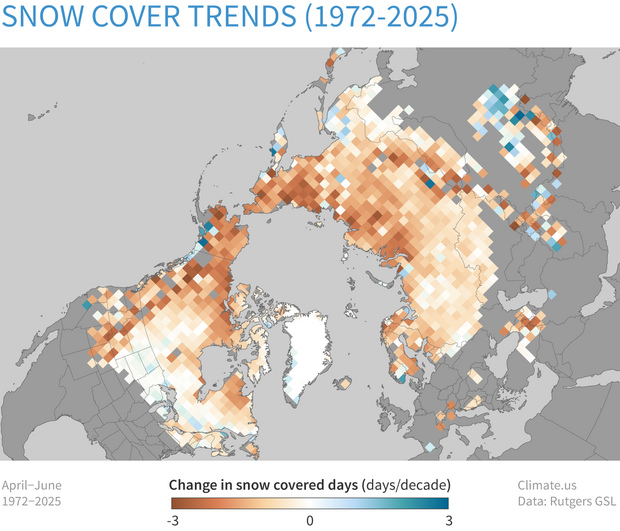
Map of April–June snow cover trends across the Northern Hemisphere from 1972–2025 based on satellite observations of the number of days each location had snow on the ground each year. Places where snow-covered days declined by up to three days per decade are shown in brown; places where snow-covered days increased by up to 3 days per decade are blue-green. (Only places that had snow in at least 25% of the years on record are included in the analysis). Most of the Northern Hemisphere has experienced declines in the number of snow-covered spring days over the past 5 decades. Climate.us map, based on data and analysis by Rutgers Snow Lab.
Natural patterns of climate variability such as the El Niño-Southern Oscillation and the Arctic Oscillation can affect the total amount of snow that falls each year. In different phases of these climate patterns, some regions receive abnormally large or small amounts of snow. While the planet still experiences differences in spring snow cover from year to year, the overall long-term trend is negative, meaning spring snow cover is declining.
Why snow cover matters: impacts of snow loss
About one-third of Earth’s land surface is covered by snow for some part of the year. At the peak of winter, about 40 percent of the Northern Hemisphere is snow-covered—which is three times the extent of Arctic sea ice. The bright white covering affects global climate by reflecting sunlight away from surfaces that would otherwise absorb it. Earlier retreat of snow cover in the spring means more sunlight absorbed by the surface, which raises temperatures. In step with earlier dates of spring budburst for many plant species, reduced spring snow cover is a sign that winter conditions are lasting for a shorter period while growing seasons are getting longer.
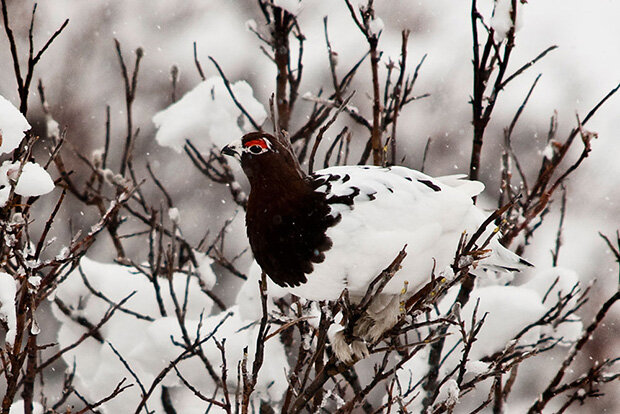
A willow ptarmigan mid-way between its brown summer and all-white winter plumage. In the cold season, these Arctic birds burrow under an insulating layer of snow that piles up in willow thickets. Lack of snow leaves them exposed to the elements and to predators. NPS photo by Tim Rains.
Locally, snow melt provides moisture to soil and plants, which means both plant growth and fire risk are affected by how long the local snow cover lasts into the spring and how slowly or quickly it melts. At regional and local scales, water resource managers, flood forecasters, and farmers are intensely interested in knowing how much water is in snow and when it will melt.
On a larger scale, runoff from melting snow feeds streams and rivers that supply water for agriculture and cities. Knowing when and how quickly snow will turn to water is essential for forecasting if water from snowmelt will soak into the ground or cause flooding. In managed watersheds, earlier melting of snow can change when and how much water is available for various uses.
Declining spring snowpack is a major water supply challenge in the American West. By one estimate, the decline in spring snowpack across the U.S. West since the middle of the 20th-century is equivalent to the volume of water in Lake Mead. Dwindling snowpack not only stresses water supplies, it also extends the length of the fire season.
Declines in snow cover over time
Northern Hemisphere snow cover declines are larger in late spring than at the start of spring. Between 1967 and 2026, April snow cover declined by 1.44 percent per decade. May snow cover declines were 4.1 percent per decade, almost 3 times faster than April declines. June snow cover declines have been faster still; through 2025, snow cover has declined by 14.6 percent per decade. (Explore trends in monthly snow cover using the Sea Ice and Snow Cover Tool at NOAA National Centers for Environmental Information.)
Looking at just the Arctic, late spring snow cover extent, duration, depth, and the amount of water stored by the snowpack are all declining. Overall, spring snow is declining in both the Eurasian Arctic and the North American Arctic, but some years still bring above-average snow cover and depth in different regions, especially in early spring months. By June, however, the surpluses have usually disappeared.
According to NOAA's 2025 Arctic Report Card, June snow cover extent (SCE) across the Arctic is half of what it was 60 years ago:
For the Arctic as a whole, May SCE has declined 15% since 1967 (-2.5 %/dec) while June SCE has declined 50% since 1967 (-8.7 %/dec). The onset of snow melt over the recent period (2010-24) has occurred 1-2 weeks earlier during May and June compared to historical conditions (1967-81) .... Corresponding declines in snow mass for the pan-Arctic region...are also large and significant in May and June (snow mass has declined by about 13% and 33%, respectively, since 1981), but during April, near the annual snow mass peak, the decline is small (about 3% since 1981) and not significant.
Measuring snow extent
Beginning in the 1960s, weekly maps of snow extent in the Northern Hemisphere have been made from satellite imagery. Now, satellites provide daily maps of snow cover for both hemispheres. Ground observations, precipitation gauges, and weather stations with pressure-sensitive “pillows” measure the amount of snow on the ground and validate the satellite maps.
References
Balik, J. A., Coop, J. D., & Parks, S. A. (2026). Snowpack decline kindles more severe fire in the western United States. Environmental Research Letters, 21(6), 064010. https://doi.org/10.1088/1748-9326/ae4e4a
Mote, P. W., Li, S., Lettenmaier, D. P., Xiao, M., & Engel, R. (2018). Dramatic declines in snowpack in the western US. Npj Climate and Atmospheric Science, 1(1), 2. https://doi.org/10.1038/s41612-018-0012-1
Mudryk, L. R., Chereque, A.E., Derksen, C., Luojus, K., and Decharme, B. (2025). Terrestrial snow cover [in “NOAA Arctic Report Card 2025”]. https://doi.org/10.25923/cfhv-c239
National Snow and Ice Data Center (n.d.) Snow: Why it matters. Access June 20, 2026. https://nsidc.org/learn/parts-cryosphere/snow/why-snow-matters#anchor-s…;
Rutgers University Global Snow Lab, Data History. Accessed August 29, 2011.
Thackeray, C. W., Derksen, C., Fletcher, C. G., & Hall, A. (2019). Snow and Climate: Feedbacks, Drivers, and Indices of Change. Current Climate Change Reports, 5(4), 322–333. https://doi.org/10.1007/s40641-019-00143-w
United States Department of Agriculture National Resources Conservation Service, SNOTEL Data Collection Network Fact Sheet. Accessed August 29, 2011.