
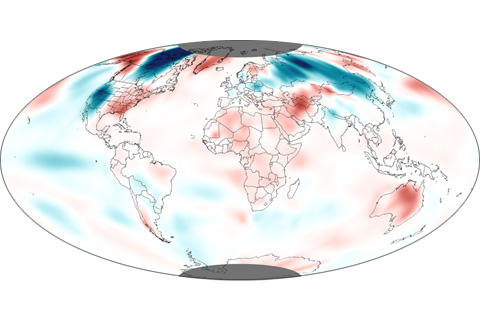
Much colder-than-average temperature during March and a strongly negative Arctic Oscillation Index reminded people in the United States how important this index is to our own climate conditions.
Much colder-than-average temperature during March and a strongly negative Arctic Oscillation Index reminded people in the United States how important this index is to our own climate conditions.
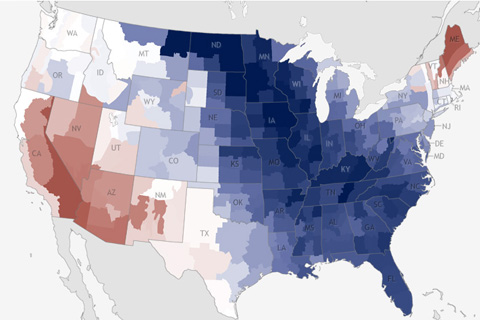
Looking at the temperature maps for March 2013, you might think that Old Man Winter over stayed his welcome or that Mother Nature was trying to make up for last March’s record-breaking heat. Much of…
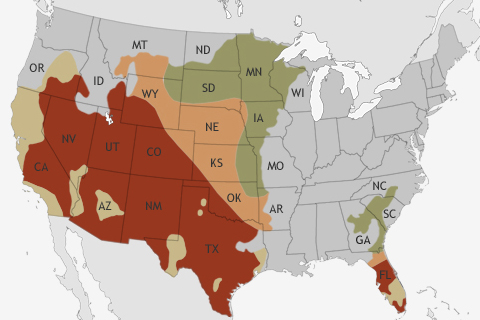
NOAA's Climate Prediction Center released its Spring Outlook on March 21. The big story for the upcoming spring? Relief for many drought-stricken areas of the United States is not likely.
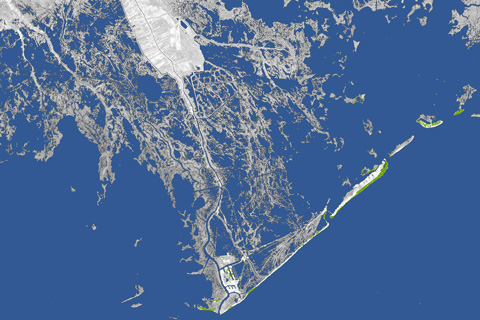
Every year, 25-35 square miles of land off the coast of Louisiana—an area larger than Manhattan–disappears into the water due to a combination of subsidence (soil settling) and global sea level rise. Toggle these maps back and forth to see how much land has been lost to the Gulf of Mexico in the past 80 years.
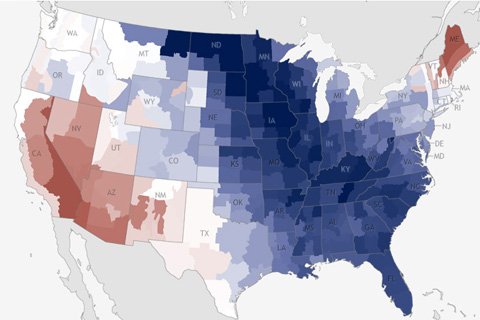
During March 2013, most of the eastern United States was notably cooler than average, with the exception of New England. Along the Rockies, temperatures were closer to normal.
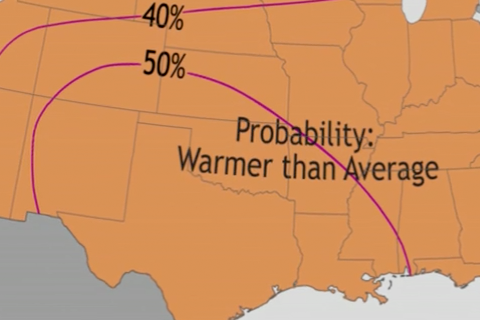
The Spring Outlook encompasses temperature, precipitation, drought, and flooding expectations for the coming three months, and Mike Halpert, Acting Director of the Climate Prediction Center, discusses the outlook and its implications.
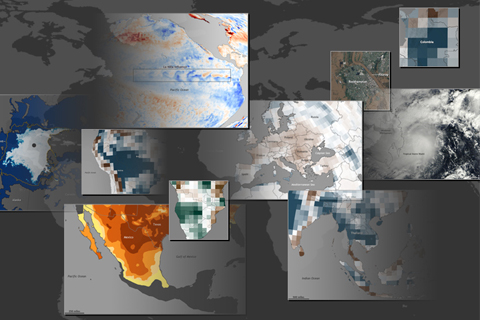
According to NOAA scientists, 2011 was a record-breaking year for climate extremes, not just in the United States, but around the world. Here's an illustrated guide to the year's top ten global climate and weather events.
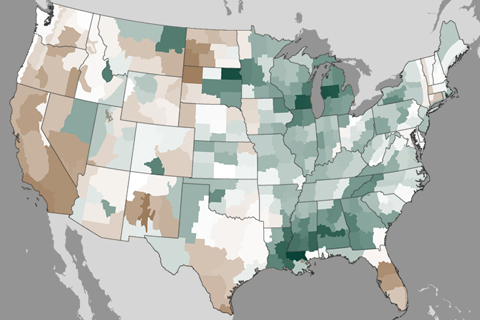
Winter storms in February improved drought in the Southeast and Midwest, but well below average precipitation in parts of the West in recent months has worsened drought in other places.
Deke Arndt, Chief of the Climate Monitoring Branch at the National Climatic Data Center, discusses snowpack in the mountainous western United States from December 2012 through February 2013.
January 2013 was the 37th consecutive January and 335th consecutive month with a global temperature above the 20th-century average. The last below-average January was in 1976.