Arctic sea ice 2026 summer minimum extent tied for 10th lowest
Details
Arctic sea ice likely reached its annual minimum extent on September 12, 2026, the National Snow and Ice Data Center (NSIDC) has announced. At 4.60 million square kilometers (1.78 million square miles), the 2026 minimum extent is statistically tied for tenth lowest in the satellite record.
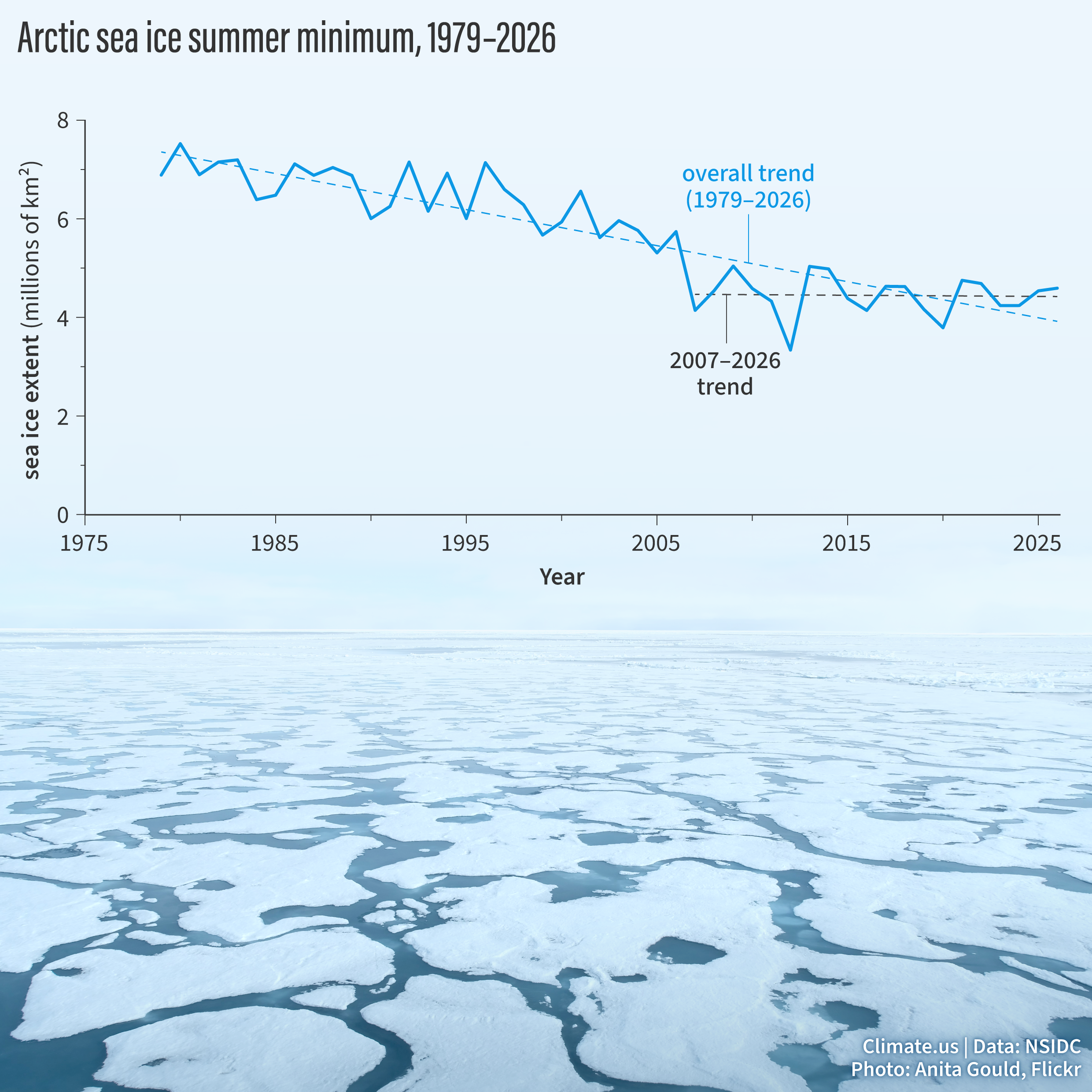
This graph shows each year’s Arctic sea ice minimum extent (blue line) over 1979–2026. The graph also shows two trend lines, for 1979–2026 and 2007–2026. The graph is derived from NSIDC’s Sea Ice Index.
Although the time series shows a clear overall declining trend, the Arctic sea ice minimum extent trend since 2007 has been near zero. NSIDC reports that scientists continue to research and debate the trend’s flattening. A major suspected cause is the steady loss of thicker multi-year ice through the 1990s and early 2000s. With the little remaining thick, older ice positioned near the pole and north of Greenland where temperatures are coldest and the summer melt season is shortest, the Arctic is in a “new normal” balance between single-year winter growth and summer decline. Natural variability may also play a role. The flattened trend does not indicate any kind of sea ice recovery. All of the 2007–2026 minimum extents are lower than those from 1979–2006.
NSIDC reports polar sea ice numbers in terms of extent: area of ocean with at least 15 percent sea ice concentration. NSIDC typically reports sea ice extent based on five-day averages to smooth out daily divergences that can give anomalously high or low values. Minimum or maximum extent values falling within 40,000 square kilometers (15,000 square miles) are considered tied, so the 2026 September minimum is tied with 2008, 2010, and 2025. In all, 13 minimum extents fall within the bottom 10, thanks to statistical ties.
Arctic sea ice extent in September 2026 was low but not unusual relative to recent years. Despite the unexceptional minimum extent, the high-latitude Arctic sea ice cover was less compacted than usual, and a large area with substantial open water formed in the western Arctic in late August. NSIDC’s Walt Meier observed, “While this year is in line with other recent low years, it was marked by late but rapid ice loss in the Beaufort and Chukchi Seas and substantial open water between Svalbard and the North Pole.”
Compared to the 1980s, Arctic sea ice is much thinner and younger. Young, thin ice is vulnerable to breakup from waves, winds, and storms.
Since the Northern and Southern Hemispheres experience opposite seasons, Antarctic sea ice often reaches its maximum extent around the time of the Arctic minimum and vice versa. As of September 23, NSIDC has indicated Antarctic sea ice may have reached its winter maximum, but the group has not yet formally called the annual maximum extent for Antarctic sea ice.
Photo of melting Arctic pack ice by Anita Gould, taken on July 1, 2026 and used under the CC BY-NC 4.0 license.