Climate experts respond to the government’s plan to amend the Fifth National Climate Assessment
Last week, the White House Science and Technology Policy Office announced via the Federal Register that they propose to amend the Fifth National Climate Assessment (NCA5), a congressionally mandated climate report published in 2023 under the guidance of a federal interagency consortium known as the U.S. Global Change Research Program (USGCRP). (The administration took the report itself offline in summer 2025. Climate.us stood up a clone of the official site at nca5.climate.us).
The public—anyone, not just scientists—can comment on these proposed amendments through Wednesday, September 9, 2026. Click on this link to the federal register notice, and look for the “submit a public comment” button near the top at the right margin of the page.
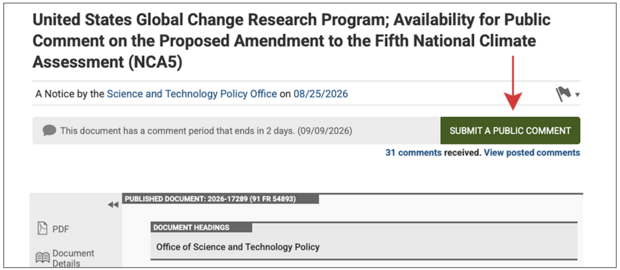
Screenshot of the federal register announcement inviting comments on proposal to amend the Fifth National Climate Assessment. Once you click the button, you will see a web form with an empty text box in which you can type your comment. You can also attach a file. You must provide an email address, but the email will not be part of the public record.
The proposed amendments to NCA5 revolve around climate scenarios known as “RCP8.5, SSP5-8.5, and SRES A2,” hypothetical future climate pathways with large increases in greenhouse gases throughout the rest of the century. These and other lower-emissions scenarios are commonly used by scientists to assess the range of possible climate outcomes under different future assumptions. Authors of the NCA5 evaluated peer-reviewed research based on these scenarios when writing their assessment of the potential risks of climate change to U.S. interests.
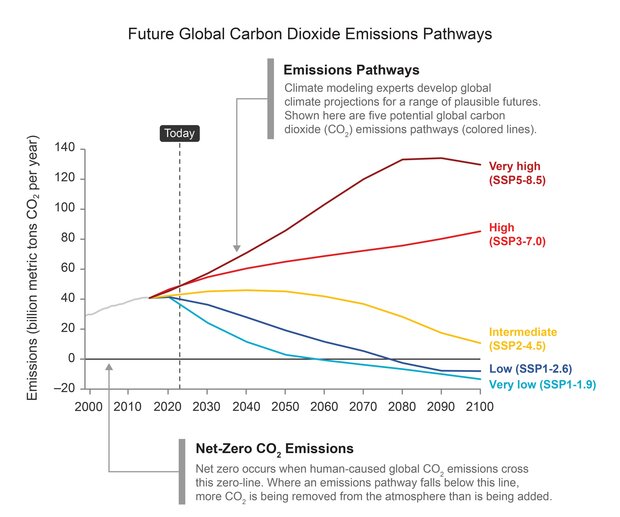
(As captioned in NCA5.) Different scenarios of future carbon dioxide emissions are used to explore the range of possible climate futures.
FIGURE 1.4. The five scenarios shown (colored lines) demonstrate potential global carbon dioxide (CO2) emissions pathways modeled from 2015 through 2100, with the solid light gray line showing observed global CO2 emissions from 2000 to 2015. See Table 3 in the Guide to the Report for scenario definitions. Many projected impacts described in this report are based on a potential climate future defined by one or more of these scenarios for future CO2 emissions from human activities, the largest long-term driver of climate change. The vertical dashed line, labeled “Today,” marks the year 2023; the solid horizontal black line marks net-zero CO2 emissions. Adapted with permission from Figure TS.4 in Arias et al. 2021.
The administration is proposing to go back to NCA5 and amend it with caveats, warnings, and prohibitions against its use by federal policy makers, planners, or communicators. Such an amendment would be unprecedented, and the administration’s notice does not explain how this will be accomplished, given that they took the official version of the NCA5–a webpage hosted by the USGCRP—offline last summer. (Climate.us stood up a complete clone of the report at nca5.climate.us). Nor does it explain how future scenarios are being treated in the next, congressionally mandated Sixth National Climate Assessment (NCA6), which by law should be published in 2027.
To help you understand the issue, we’ve pulled together this page linking to background reading as well as public comments that some climate experts have posted to their own social media or blogging platforms. The opinions expressed belong to the scientists themselves, not Climate.us.
Marcus C. Sarofim, climate scientist & policy analyst
Quote of the piece:
National Climate Assessments are required by the Global Change Research Act of 1990 (GCRA). Every assessment produced under it has been developed through steering committees, named author teams, public comment, interagency review, and National Academies review. There is no established mechanism for post-hoc “amendments” to completed assessments. Even if there were, the NCA is a Highly Influential Scientific Assessment (HISA) and must meet Information Quality Act (IQA) standards for transparency, independence, expertise, and public documentation of review. This amendment does not meet any of these standards: no disclosed process (transparency), no identified reviewers (independence), no named authors (expertise), no peer review plan (public documentation of review).
William Hohenstein, former director (retired) of USDA’s Climate Change Program Office and Office of Energy and Environmental Policy
Quote of the piece:
The NCA5 is designated a “Highly Influential Scientific Assessment” and underwent extensive formal review and comment before publication in 2023. The process included an independent review by the National Academies of Sciences, Engineering, and Medicine and multiple levels of scientific, technical, government, and public review and comment. The report was published following formal approval by the 15 federal agencies that comprise the US Global Change Research Program. The objectives of the proposed changes are to eliminate the high emissions scenarios from consideration and downplay the negative consequences of climate change.
Phil Duffy, chief scientist at Spark Climate Solutions
Quote of the piece:
If OSTP feels that it is important to retroactively reassess the plausibility of emissions scenarios used in NCA5, it should also reassess SSP1-1.9, a low-emissions scenario which is also used in NCA5. This low-emissions scenario is … at least as implausible as RCP8.5 and SSP8.5, and the fact that OSTP is focusing only on those high-emissions scenarios suggests that OSTP’s actions are an attempt to promote the false narrative that NCA5 overstated the risks of climate change.
Michael Chang, director at Cascadia Consulting Group
Quote of the piece:
While lots have been said and published about high emissions scenarios – whether it shows the range of potential futures, whether it’s useful to illustrate potential intensity of extreme events and can act as a useful “stress test”, or whether it shows an unlikely future climate scenario – these discussions are happening in peer-reviewed publications and deliberative discussions that are informing future climate assessments such as the IPCC AR7 (i.e., the scientific process).
Margaret Walsh, research professor and director of research development, University of Connecticut
Quote of the piece:
Science needs to inform policy. The NCA5 adhered to every requirement and review standard for a Highly Influential Scientific Assessment, to the letter. Selective disregard of its findings leaves us blind and vulnerable to the real effects of climate change. Any alteration requires the same rigor, transparency, and independent review that the original report received.
Andrew Dessler, professor of atmospheric and climate science, Texas A&M
Quote of the piece: [comparing the spread of possible warming in RCP8.5 vs. RCP4.5, a more moderate emissions scenario]
Let me be precise about what this result means. This analysis shows that we cannot rule out that the real climate system driven by a SSP2-4.5 emissions delivers warming at the end of the century equal to what a typical model produces under SSP5-8.5 (around 4°C). The median temperatures in the RCP8.5/SSP5-8.5 ensemble are therefore plausible, even if the emissions that produced them are not.
Izzy Pacenza, Shannan Lenke Stoll, and Abby Chernila, Environmental Data and Governance Initiative
Quote of the piece:
As the administration rewrites climate projections made almost three years ago, they are also crippling our ability to continue evaluating climate impacts in the future. In April 2025, the administration halted work on the 6th NCA set to be released in 2028 and dismissed all of the public servants drafting it. Three months later, the USGCRP’s entire website went dark, taking with it the primary portal for public access to all existing NCAs. … The continued provisioning of information like the NCAs that are tailored to the science and circumstances of the moment is integral to moving forward in a climate-impacted world.
Robert Kopp, climate and sea-level scientist and climate policy scholar at Rutgers University Department of Earth & Planetary Sciences.
Quote of the piece:
High-end simulations help define the shape of the relationship between warming and damages, especially in the upper tail where nonlinear impacts become important. Eliminating these simulations from consideration would reduce information relevant to understanding high-end but potentially consequential outcomes… .
More generally, policy relevance is not synonymous with probability. Flood-control systems, coastal infrastructure, emergency management plans, financial stress tests, and other risk-management tools routinely evaluate outcomes that are not expected but are possible and consequential. The amendment never explains why the National Climate Assessment should abandon this widely accepted principle.
Background reading
You don’t have to be an expert on modeling scenarios to comment on the proposed amendments to NCA5. But if you want a deeper understanding, these links offer a variety of perspectives on how scenarios are created, as well as their strengths and limitations.
- Explainer: Scenarios for CMIP7 from the Coupled Model Intercomparison Project is a brief overview of the scientific paper The Scenario Model Intercomparison Project for CMIP7 (ScenarioMIP-CMIP7), which covers the new scenarios in detail.
- Emissions – the ‘business as usual’ story is misleading
- Factcheck: Trump’s false claims about the IPCC and ‘RCP8.5’ climate scenario
- How climate scenarios lost touch with reality
- On the death of RCP8.5
- A Practitioner's Guide to Climate Model Scenarios
- Limiting Overshoot - Navigating exceedance of 1.5°C and pathways towards return