Blogs
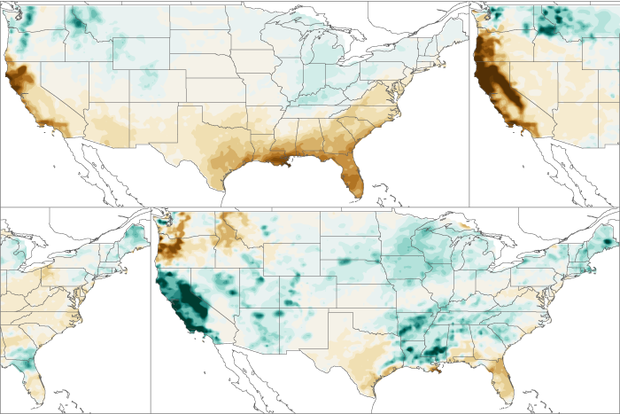
Right now, with La Niña conditions currently underway, I guarantee at least one of our readers is currently thinking “This alleged ‘La Niña’ is going to bust so hard in my region. It’s supposed to be DRY and it’s been WET so far. What the heck is wrong with you people!? BUST, BUST, BUST…” It’s frustrating! I get it! That’s because I too am human and get weirdly annoyed when the forecast is for something I want to happen, say 5 inches of snow, and then we end up with dry pavement. But, being a scientist, I also realize that weather and climate predictions contain uncertainty. And uncertainty stinks especially when you really want that outcome to materialize.
So, today I am going to try to …
Read article
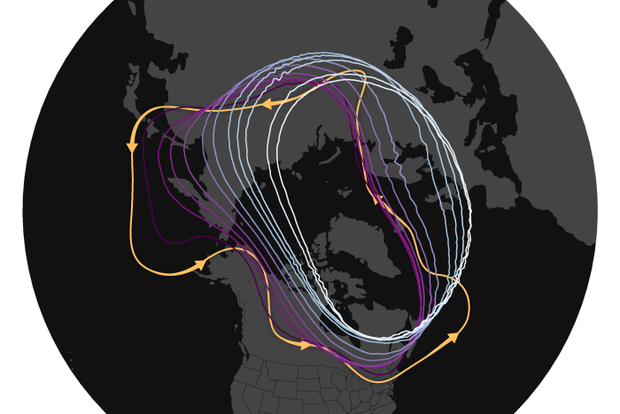
We’re briefly popping in because another surge of very cold air looks to drop down from the Arctic over a large region of the central US this weekend and into early next week. We know that the question will be asked: is the cold related to the polar vortex this time? So here we are to provide some answers.
There are two points we want to emphasize:
1. The polar vortex strength, as measured by the speed of the winds around the 60N latitude circle and 10 hPa pressure level, remains stronger than average, and is currently forecast by most models to return to near-record strong wind speeds into early February.
Normally, if the polar vortex is communicating with the surface, which it…
Read article
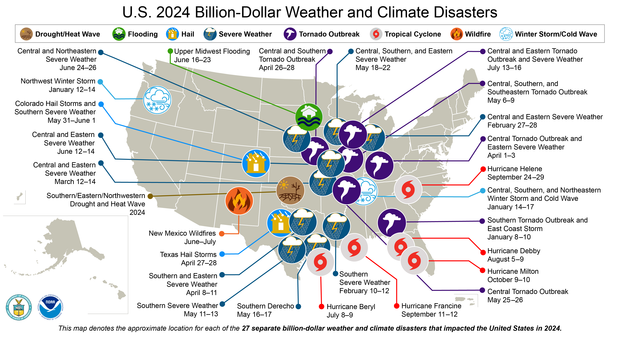
NOAA’s National Centers for Environmental Information (NCEI) has updated its 2024 Billion-dollar disaster analysis. In 2024, there were 27 individual weather and climate disasters with at least $1 billion in damages, trailing only the record-setting 28 events analyzed in 2023. These disasters caused at least 568 direct or indirect fatalities, which is the eighth-highest for these billion-dollar disasters over the last 45 years (1980-2024). The cost was approximately $182.7 billion.
This total places 2024 as the fourth-costliest on record, trailing 2017 ($395.9 billion), 2005 ($268.5 billion) and 2022 ($183.6 billion). Adding the 27 events of 2024 to the record that begins in 1980, th…
Read article
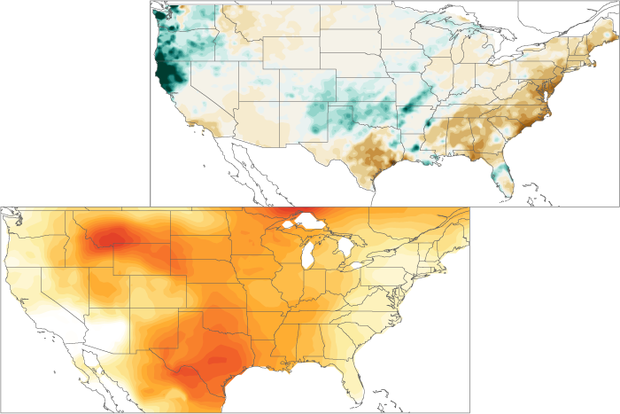
La Niña conditions emerged in the tropical Pacific in December. There’s a 59% chance La Niña will persist through February–April, followed by a 60% chance of neutral conditions in March–May. Read on for the recent observations that led us to declare the (long-awaited) onset of La Niña and lots of details for current and potential upcoming conditions.
Just the facts, ma’am
A quick briefing, if you’re just joining us—La Niña is one phase of the El Niño/Southern Oscillation (ENSO), a pattern of sea surface temperature and atmospheric changes in the tropical Pacific Ocean. La Niña’s signature is cooler-than-average surface water in the east-central Equatorial Pacific, while its counterpart…
Read article
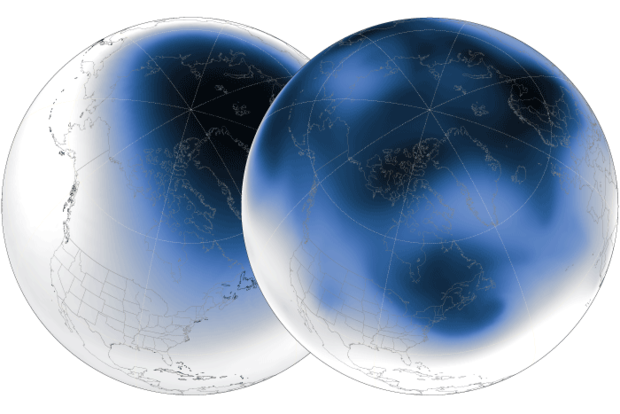
Parts of the Midwest and East Coast have been blanketed by the first major snow of 2025, with temperatures dropping as fast as my New Year’s resolutions. Do we have the stratosphere, the polar vortex in particular [footnote #1], to blame (or thank) for this recent cold air outbreak? We don’t think so. This seems like a case of the polar vortex getting blamed for being a trouble maker, when it was actually minding its own business. We’ll tell you why below.
Our usual suspect has an alibi: the polar vortex has been strong
A common way in which the stratospheric polar vortex contributes to cold air outbreaks over the eastern U.S. usually involves two key ingredients.…
Read article