2026 Antarctic sea ice winter maximum is third lowest of satellite record
Details
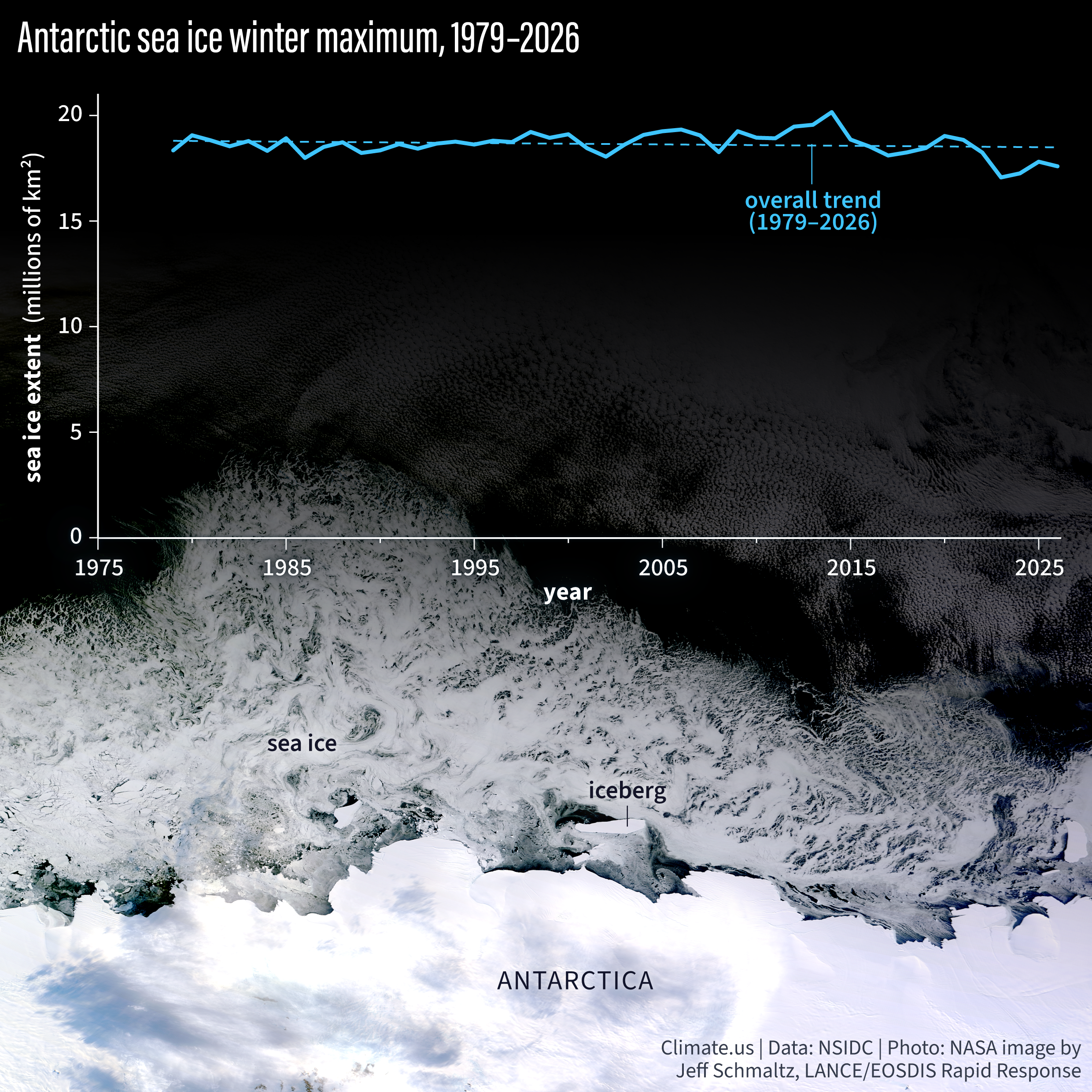
Antarctic sea ice probably reached its winter maximum extent on September 14, 2026, according to the National Snow and Ice Data Center (NSIDC). At 17.59 million square kilometers (6.79 million square miles), the 2026 annual maximum is third lowest in the satellite record, behind 2024 and 2023 (the record low). The last four years have experienced the lowest four winter maximum extents on record.
This graph shows each year’s Antarctic sea ice maximum extent (blue line) over 1979–2026. The graph also shows the long-term trend (dashed light blue line); however, this trend is not statistically significant. The graph is derived from NSIDC’s Sea Ice Index. Extent is the area of ocean with at least 15 percent sea ice concentration.
Arctic sea ice has shown a clear decline over the satellite record, but Antarctic sea ice has behaved differently. Since the start of the satellite record in late October 1978, the Antarctic trend has been near zero, with year-to-year variability overwhelming trends. The low extents of recent years have tugged trends for all months into negative territory, but in only one month—November—is the declining trend significant, just barely.
Ted Scambos, a research scientist at the Cooperative Institute for Research in Environmental Sciences (CIRES) and a contributor to NSIDC’s Sea Ice Today, cautions against linking recent downturns in Antarctic sea ice to climate change. He states, “It’s still hard to be sure about global warming and Antarctic sea ice. Even with 48 years of data, we have never had a solid trend; 2013 and 2014 surged, then in late 2015 it plummeted and it's been below the long-term average ever since. Several recent studies have implicated warmer ocean water mixing into the uppermost ocean polar layer; if that cause (warmer near-surface polar water) and effect (less sea ice) both persist, I would lean toward anthropogenic [human-caused] global warming as the cause.”
After reaching its winter maximum, Antarctic sea ice began to rapidly decline as Southern Hemisphere spring progressed. The melt was so rapid that as of early October 2026, Antarctic sea ice extent reached a new record-low extent for this time of year in the satellite record. NSIDC researchers continue to watch sea ice—in both hemispheres—closely.
If you would like to explore sea ice observations in more detail, visit NSIDC’s comparison tool to compare monthly trends over the course of the satellite record, and NSIDC’s Charctic tool to examine daily extents across the satellite record.