The ENSO blog is dead. Long live the ENSO blog!
The second Thursday of each month is ENSO-forecast day at NOAA, the day that the agency weighs in on whether ENSO—short for El Niño-Southern Oscillation—is currently warm (El Niño), cool (La Niña), or neutral, and how likely it is to stay that way in coming months. It’s a big day because ENSO is a big deal, the single most influential natural climate phenomenon on Earth. By disrupting normal ocean temperature and rainfall in the tropical Pacific for months on end, El Niño and La Niña interrupt the general flow of the atmosphere around the planet, setting the stage for drought in some places and deluge in others.
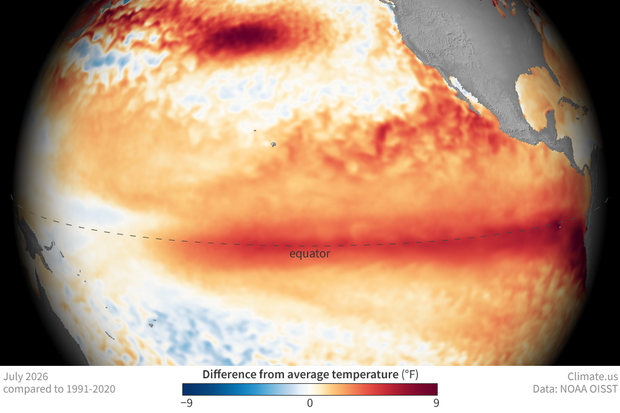
Sea surface temperatures in the Pacific Ocean in July 2026 compared to the 1991-2020 average. Temperatures across the equator were warmer than average (orange, red), a sign that El Niño has emerged. Climate.us image, based on NOAA OISST data.
As expected, NOAA released its latest update on El Niño earlier this morning. The current El Niño is getting stronger, and there’s a 69% chance that when it peaks later this winter, it will do so as the strongest event in the historical record back to 1950. Strongest ranked by the predicted RONI value, at any rate, which I am going to emphasize (because in some corners of the internet, people are losing their minds over this) is NOT THE SAME THING as “strongest ranked by impacts.”
RONI, which is short for Relative Oceanic Niño Index, is a way of gauging how unusual the temperatures in the tropical Pacific are compared to the rest of the tropical ocean. A big, positive RONI value means it’s very warm there compared to average and to the rest of the tropics. It’s the key measure of the strength of the ocean part of El Niño, which is directly tied to some of ENSO’s impacts, like coral bleaching or crashing populations of penguins and other marine life in the Galapagos.
But the ocean is only half of ENSO, and once we start bringing the atmosphere into things, predicting the impacts gets more complicated. Why? Because the atmosphere is just less predictable than the ocean. At any given time, there are a lot of different things going on in the atmosphere, and even a strong influence like El Niño doesn’t dictate what it is going to happen with 100% certainty. That said, with a very strong El Niño, we have higher confidence that we’ll see the expected impacts, so now’s the time to learn about the typical impacts where you live.
But as long as you promise to keep in mind that sometimes, El Niño is like a bad bartender (I know that post is “old,” but it is one of the best ENSO-impact metaphors I’ve read!), it’s OK to gawk at just how hot the ocean is, not just at the surface, but down below.
Five-day-average temperature compared to the long-term average (1991-2020) from April 3 to July 22, 2026. Climate.us animation, based on NOAA data.
The ENSO Blog’s new era
We decided to use ENSO-forecast day to make an ENSO-related announcement of our own. Starting next week, we will be taking some baby steps toward rebooting the ENSO Blog, which ran on Climate.gov from May 2014–June 2025. The ENSO Blog was among the most read parts of Climate.gov, and its followers were among our most dedicated, reading posts in depth and sparking great dialogue with their questions. (In a spirit of humility, I will admit that at least some of them were likely a captive audience, since more than one instructor wrote to tell us they had made the blog required reading for their students).
We are no longer part of NOAA, so we won’t have our full cast of characters from the old team. This makes me so sad I can’t say anything more about it.
Happily, though, we will have former blogger Emily Becker, Deputy Director at the University of Miami’s Cooperative Institute for Marine and Atmospheric Studies, who has agreed to help us carry on the original blog’s legacy. Emily—whose Poe-invoking subhead inspired my one of my favorite ENSO-themed cartoons—will be our lead going forward. We are shooting to publish her first post sometime later this month, perhaps even next week.
As I said, we’re taking baby steps. With a smaller team, we’ll have fewer and shorter posts. We haven’t yet gotten the comment module reinstalled, so for a while, you’ll have to engage with us on social media or send questions to the general mailbox. Emily’s first post is going to dig into the difference between RONI and our original-flavor ENSO tracker, the traditional Oceanic Niño Index. If you have ideas for what should come after that, let us know.
The ENSO Blog is dead.(<sniff>) Long live the ENSO Blog!